 EN
EN
Unwavering Support for Healthcare Providers
2026/02/25
2026/03/09
Author: Dr. Wei Li (李伟), PhD
Chief Technology Officer & Head of R&D at VistaMed Technologies
As the architect of VistaMed's technology, Dr. Li leads the engineering teams behind the company's entire product portfolio and is the lead inventor on a significant portion of the company's 87 granted patents.
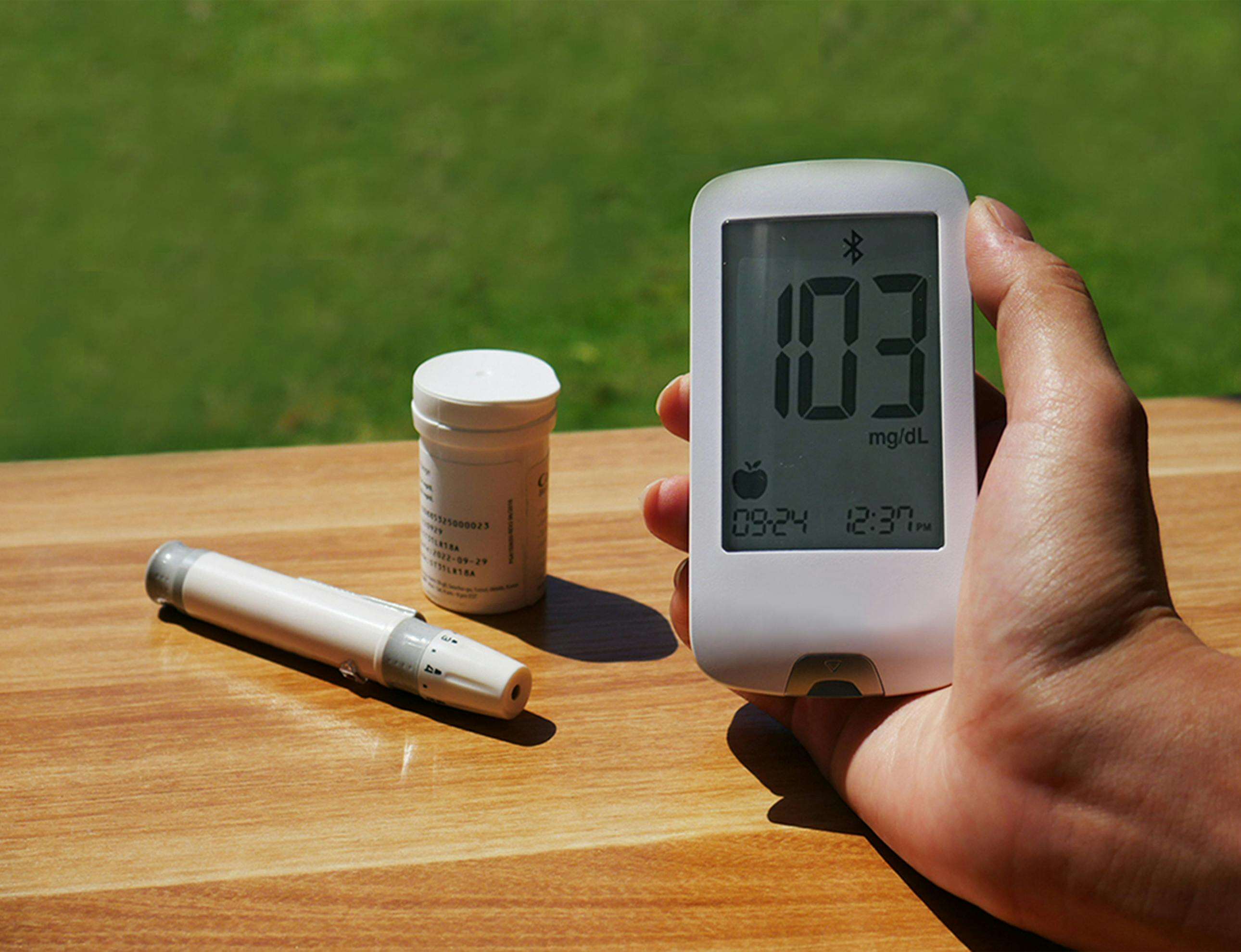
I have a shelf in my Shenzhen R&D lab that I call "the island of misfit toys." It's where we put the competitor devices we've taken apart. A few months ago, we acquired a new, popular Blood Glucose Monitoring System (BGMS). I ignored the meter and took a vial of their test strips straight to one of our high-powered digital microscopes. What I saw was exactly what I expected. The carbon electrodes, which are supposed to be precise, uniform pathways for the electrochemical reaction, looked like blurry roads painted by a shaky hand. The edges were fuzzy, and the surface texture was inconsistent from one strip to the next in the very same vial.
This is the dirty secret of blood glucose monitoring. The meter is just a reader. The real medical device, the part where all the critical science happens, is the disposable test strip. And in my experience, that's where most companies fail. They sell a sophisticated meter and a cheap, inconsistent strip, and then they ask the patient to fix their manufacturing flaws with a "calibration code." From an engineering perspective, this is an unacceptable compromise.
Engineers at other companies often focus on the meter—the processing power, the display, the memory. This is a mistake. The meter's job is simple: apply a voltage and measure a current. The test strip's job is to perfectly manage a complex electrochemical reaction in a fraction of a second.
This is why, in many regulatory jurisdictions, the strips are considered the higher-risk component. The rigor required for a Class III medical device registration with China's National Medical Products Administration (NMPA), for example, places immense scrutiny on the manufacturing and quality control of the test strips themselves. As an engineer, you should always vet the strip first. The meter is secondary.
The vast majority of test strips on the market use electrodes made by screen-printing carbon-based ink onto a plastic substrate. It's a fast, cheap, and well-established process. It is also, in my opinion, woefully imprecise for a life-critical measurement. Under a microscope, a screen-printed electrode looks like a rough, blurry coastline. The edges are ill-defined, and the electrical properties of the carbon ink can vary based on its thickness and composition. This creates a different reaction environment on every strip, which is a major source of the batch-to-batch variability that makes manual coding necessary.
Our approach is fundamentally different. It's borrowed from the semiconductor industry. We start with a substrate film that has been sputter-coated with a thin, uniform layer of a palladium-gold (Pd-Au) noble metal alloy. We then use a high-precision laser to ablate the material, carving out the electrode pattern. The result is a set of electrodes with nanometer-level precision. The geometry is perfect. The reaction area is identical on every strip. The conductivity of the Pd-Au alloy is orders of magnitude more stable than carbon ink. It looks like a circuit etched onto a silicon wafer. Clean lines, perfect geometry.
From the CTO's Desk
"The enzyme reaction is a fire. A screen-printed strip gives it a ragged, unpredictable clearing to burn in. Laser ablation carves a perfect, identical fire pit for every single strip. That control over the reaction geometry is the key to eliminating the need for coding. We control the physics in the factory so the patient doesn't have to guess at the chemistry in their home."
– Dr. Wei Li (李伟), PhD
If the electrodes are the fire pit, the glucose oxidase or FAD-GDH enzyme is the fuel. This biological component is the engine of the strip, and it is incredibly fragile. Its activity is highly dependent on temperature and humidity during the manufacturing and drying process.
This is another area where cutting corners leads to inconsistency. We apply our proprietary enzyme formula inside a Class 100,000 cleanroom. The temperature is held to 22°C (±1°C) and the relative humidity is locked at 45% (±2% RH). These aren't arbitrary numbers. These are the validated parameters that ensure the enzyme layer dries in a uniform crystalline structure, preserving its activity and guaranteeing a consistent reaction speed from the first strip in a batch to the millionth. It is this process control that allows us to meet the stringent accuracy requirements of the ISO 15197:2013 standard for blood glucose monitoring systems.
A "no-coding" system is the ultimate engineering statement. It declares that your manufacturing process is so consistent that the meter's algorithm doesn't need to be adjusted for each new vial. It is the output of a mature quality system.
This engineering discipline has tangible downstream effects. A simpler, more reliable device is easier to use and less prone to failure. In a large-scale project with Unity Health System, they standardized their professional monitoring devices on the VistaMed platform. The result was a 41% decrease in maintenance-related downtime and a 47% reduction in nurse training time. While this study focused on our BP monitors, the underlying philosophy is the same. We engineer out the complexity and the potential points of failure at the component level, which translates directly to a more robust and reliable system in the field.
What specific enzyme and mediator system do you use, and why?
For our latest generation of strips, we use a highly stable, mutated variant of the FAD-GDH (flavin adenine dinucleotide glucose dehydrogenase) enzyme. Unlike glucose oxidase (GOD), FAD-GDH does not react with oxygen in the blood, which means it is not affected by maltose or galactose, reducing the risk of interference from certain non-glucose sugars. The mediator is a proprietary osmium-based complex, which we selected for its rapid and efficient electron transfer, allowing for a very fast measurement time with a small sample volume.
How do you account for hematocrit variation in your algorithm?
This is a critical question, as hematocrit level significantly affects blood viscosity and the speed of the reaction. We use a multi-faceted approach. The strip itself has a second set of electrodes that perform an AC impedance measurement as the blood sample wicks in. This measurement provides a reliable estimate of the hematocrit level. The meter's algorithm then uses this hematocrit value as an input, along with the primary current measurement from the glucose reaction, to calculate a compensated glucose value. It is a real-time correction that happens within the measurement cycle.
What is the shelf life of your strips, and what stability studies do you perform?
Our strips have a validated 24-month shelf life after manufacturing. This is validated through an extensive, ongoing stability testing program. We perform both real-time and accelerated aging studies as per international guidelines. Batches are stored at a range of elevated temperatures and humidity levels (e.g., 40°C/75% RH) and tested at regular intervals to model long-term stability and ensure that the strips will perform accurately up to their printed expiration date, even after being shipped through variable climates.
About the Author
Dr. Wei Li (李伟), PhD serves as Chief Technology Officer & Head of R&D at VistaMed Technologies. With over 20 years of experience in biomedical engineering, he is the driving force behind VistaMed's technological innovation and the lead inventor on a significant portion of the company's 87 granted patents. His leadership was instrumental in the development of the IntelliScan AI Diagnostic System, which earned both the MedTech Breakthrough Award (2024) and the Red Dot Design Award (2023). This article reflects his deep engineering expertise and his perspective on building secure, reliable, and integration-ready medical devices.
Clinically & Regulatory Reviewed By: Dr. Michael Bauer, PhD, Head of Clinical Research
The information provided is for informational purposes and intended for a B2B audience of healthcare professionals and procurement decision-makers. It is not a substitute for professional medical or financial advice. TCO and ROI results may vary based on facility size, usage patterns, and local market conditions. All certifications and regulatory clearances referenced are accurate as of the date of publication. Please contact VistaMed Technologies for the most current documentation.

2026/02/25