 EN
EN
Unwavering Support for Healthcare Providers
2026/02/25
2026/03/06
Author: Dr. Wei Li (李伟), PhD
Chief Technology Officer & Head of R&D at VistaMed Technologies
As the architect of VistaMed's product portfolio, Dr. Li leads the engineering teams that develop our devices from the component level up, holding a significant portion of the company's 87 granted patents.
I have a graveyard of competitor "health watches" in my lab. When a new consumer wearable gains popularity, my team and I acquire one and perform what we call a "teardown and truth" analysis. We tear down the hardware, and we look at the truth of the raw, unfiltered data coming from its sensors. The results are almost always the same.
On the outside, a beautiful, sleek device. On the inside, a mess. The raw ECG signal is a chaotic scribble, riddled with electrical noise and motion artifact. The pretty tracing on the watch's display is an illusion—a heavily processed, "airbrushed" image created by an algorithm that erases both the noise and the subtle clinical details a doctor needs to see.
This is the fundamental, dangerous flaw in the consumerization of medical technology. A medical device is not an accessory. It is an instrument. And the quality of that instrument is not determined by its marketing budget; it is determined by the engineering discipline on the factory floor.
For a device worn against the skin for days or weeks at a time, the choice of material is not just aesthetic; it's a critical safety and performance feature. Many consumer wearables use inexpensive, rigid ABS plastics and chrome-plated metals. In my experience, this is a recipe for failure in a clinical context. Patients develop skin irritation. The devices are difficult to properly sanitize between users. The casings crack under the stress of daily use.
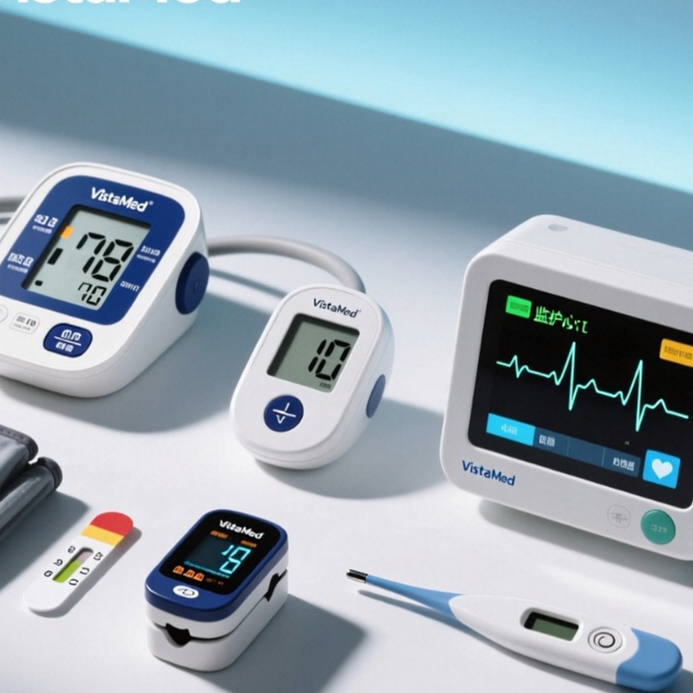
A medical-grade wearable must be built differently. For the casings of our wearable monitors, we use a specific grade of medical liquid silicone rubber (LSR). It's flexible, completely waterproof, and, most importantly, it is biocompatible, meaning it's been tested for cytotoxicity and sensitization. The electrodes that make contact with the skin aren't shiny chrome; they are medical-grade 316L stainless steel, the same material used for surgical implants, to ensure a clean signal and minimize the risk of allergic reactions. This is a detail your customers’ patients will notice, and their risk managers will demand.
Capturing the heart's tiny electrical signal—a signal that is only one-thousandth of a volt by the time it reaches the skin—is an immense engineering challenge. The "dry" electrodes on a wearable are the gateway. Their ability to make a stable, low-noise connection without conductive gel is paramount. This requires not just the right material (like our 316L steel) but the right shape and pressure to maintain contact as a patient moves.
Once the signal is captured, it enters the most critical chip on the circuit board: the Analog Front-End (AFE). The AFE's job is to find that whisper of a signal in a hurricane of noise from muscle movement and electrical interference. We select AFEs designed specifically for biopotential measurement, ones with an extremely high common-mode rejection ratio (CMRR) of over 100 decibels. This allows the chip to aggressively reject the electrical "hum" from a room's lighting while precisely amplifying the delicate cardiac signal. A generic AFE from a consumer gadget simply cannot do this reliably.
A CTO's Perspective
"Software cannot fix bad physics. An algorithm cannot invent a cardiac signal that the hardware failed to capture. My team's obsession is capturing the cleanest possible signal at the very first point of contact. Every engineering choice—the electrode material, the circuit layout, the AFE selection—serves one purpose: to give the software an honest, uncorrupted signal to analyze. That is the foundation of trust." – Dr. Wei Li (李伟), PhD
Before you put your brand and your reputation on a wearable device, you must ask the hard questions. Go beyond the sales brochure and ask the questions an engineer would ask.
Making one perfect device is easy. Making a million of them, all identical, is the real challenge. This is where our BSI-audited ISO 13485:2016 Quality Management System (Certificate No. FS 738429) becomes the ultimate guarantee for our distribution partners.
Our QMS governs every single step. It dictates how we test each batch of 316L steel for impurities. It mandates that every AFE chip is traceable to its source. It ensures that every line of our SaMD algorithm code is reviewed, validated, and documented before it is ever deployed.
This fanatical commitment to process is what creates devices that are not just accurate, but astonishingly reliable. It's the reason why, in a large-scale deployment with Unity Health System, standardizing on our professional monitoring platform—which is built with the same philosophy—led to a 41% decrease in maintenance-related downtime. For a hospital, that's a massive operational saving. For you, the distributor, it's a powerful story that proves the long-term value of a well-engineered product.
How do you test the durability of a wearable that's worn 24/7?
Our reliability lab is where our products go to be tortured. We have custom-built machines that simulate years of being put on and taken off. We have chambers that subject them to a salt-mist environment to test the corrosion resistance of the electrodes. We immerse them in cleaning solutions to test the durability of the casing. We perform drop tests, vibration tests, and electrostatic discharge tests. The device you sell is one that has already survived the worst we can throw at it.
My customers are concerned about data security with a connected wearable. How is that addressed in manufacturing?
Security is designed in, not bolted on. It starts at the hardware level with a dedicated cryptographic chip that manages encryption keys. The firmware is designed to prevent unauthorized access. The Bluetooth communication uses the latest secure pairing protocols. Our entire process is designed to meet the stringent cybersecurity expectations of healthcare IT departments and regulators. We build our devices to be trusted components in a secure ecosystem.
What level of customization is possible for a private-label (OEM/ODM) wearable?
For a true partner, it goes far beyond just a logo. We can offer custom colors and finishes for the silicone casing, a fully branded user experience in the companion software app, and custom-designed packaging. Our goal is to provide you with a unique product platform that you can use to build your own defensible brand in your market.
About the Author
Dr. Wei Li (李伟), PhD serves as Chief Technology Officer & Head of R&D at VistaMed Technologies. With over 20 years of experience in biomedical engineering, he is the driving force behind VistaMed's technological innovation and the lead inventor on a significant portion of the company's 87 granted patents. His leadership was instrumental in the development of the IntelliScan AI Diagnostic System, which earned both the MedTech Breakthrough Award (2024) and the Red Dot Design Award (2023). This article provides a rare, inside look into the manufacturing philosophy and engineering discipline that he has instilled in the VistaMed R&D and production teams.
Clinically & Regulatory Reviewed By: Dr. Michael Bauer, PhD, Head of Clinical Research
The information provided is for informational purposes and intended for a B2B audience of healthcare professionals and procurement decision-makers. It is not a substitute for professional medical or financial advice. TCO and ROI results may vary based on facility size, usage patterns, and local market conditions. All certifications and regulatory clearances referenced are accurate as of the date of publication. Please contact VistaMed Technologies for the most current documentation.

2026/02/25