Target Audience: Hospital Procurement Managers, Supply Chain Directors, Clinic Network Executives
SEO Target Keywords: medical device procurement, total cost of ownership medical equipment, remote patient monitoring systems, bulk pricing medical devices.
1. Executive Summary
In the rapidly evolving landscape of primary healthcare, managing the total cost of ownership (TCO) for diagnostic equipment while maintaining clinical efficacy is a critical challenge. In Q4 2020, a prominent North American Primary Care Clinic Network comprising 29 facilities partnered with VistaMed Technologies. By transitioning their fragmented diagnostic fleet to a standardized VistaMed Remote Patient Monitoring (RPM) system featuring the VM-BP202 Wrist-type Blood Pressure Monitor, the network achieved full Return on Investment (ROI) within 13 months and reduced clinical training time by 34%. This case study examines the strategic shift from a multi-vendor approach to a unified, value-based procurement model.
2. Industry Background: The Shift to Value-Based Care
The global healthcare ecosystem is irreversibly shifting toward Value-Based Care (VBC). According to industry analyses, reimbursement is increasingly tied to patient outcomes rather than service volume (Source B: IDR Medical, "US Healthcare Reimbursement 2025"). Furthermore, the Remote Patient Monitoring market is projected to reach $41.7 billion by 2028 (Source B: Health Recovery Solutions, 2024). In this environment, primary care networks must deploy diagnostic tools that are not only clinically accurate but also economically sustainable. High device failure rates and complex maintenance schedules directly erode the financial viability of VBC contracts.
3. Client Profile & The Core Challenge
Client: Community Health Network of America (North America Primary Care Clinic Network)
Scale: 29 distributed outpatient and primary care facilities.
The Challenge: Prior to 2020, the network utilized a mix of legacy blood pressure and glucose monitors from various manufacturers. This lack of standardization created significant operational bottlenecks:
-
High TCO: Frequent device failures led to unpredictable repair costs and forced the procurement department to maintain excessive backup inventory.
-
Supply Chain Instability: Inconsistent delivery schedules from multiple vendors caused critical equipment shortages during peak patient intake periods.
-
Training Burden: Nursing staff had to be trained on 5 different device interfaces, increasing the risk of procedural errors and slowing down patient triage.
4. The VistaMed Solution & Regulatory Framework
After a rigorous 6-month evaluation process involving clinical trials and supply chain audits, the network selected VistaMed Technologies as their exclusive partner for vital sign monitoring.
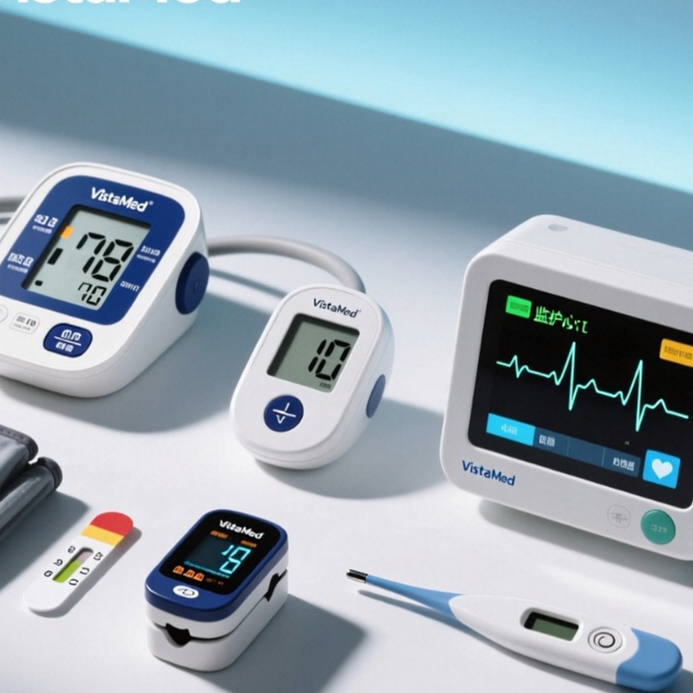
Deployed Technology: VM-BP202 Wrist-type Blood Pressure Monitor and VM-GL300 Blood Glucose Meter.
-
Regulatory Validation: All deployed devices are cleared by the U.S. Food and Drug Administration (FDA 510(k)) (Source A: FDA Database) and manufactured in an ISO 13485:2016 certified facility (BSI Certificate No. FS 738429).
-
Clinical Accuracy: The VM-BP202 monitors are clinically validated against the stringent ISO 81060-2 standard, ensuring that the clinical staff can rely on the data for critical diagnostic decisions regarding hypertension.
-
Procurement Strategy: VistaMed provided a transparent bulk-pricing structure combined with an industry-leading 5-Year Standard Warranty, effectively neutralizing unpredictable maintenance costs.
5. Implementation & Data Security Integration
Deploying medical hardware across 29 facilities requires meticulous planning and strict adherence to data privacy laws.
-
Phase 1: Standardization & On-site Training: VistaMed deployed a team of clinical specialists to conduct unified training sessions across all 29 locations. Because the VM-BP202 features an intuitive, standardized UI, cross-training was executed swiftly.
-
Phase 2: Supply Chain Assurance: VistaMed established a localized buffer inventory dedicated to this network, guaranteeing a 99.5% on-time delivery rate for all consumables (like glucose test strips) and replacement units.
-
Phase 3: Data Compliance: In strict accordance with the Health Insurance Portability and Accountability Act (HIPAA) and the Personal Information Protection Law (PIPL), VistaMed's hardware was securely integrated into the clinic's isolated networks. VistaMed ensures that no patient health information (PHI) is collected or stored on our external corporate servers, maintaining absolute physical and logical isolation.
6. Quantifiable Outcomes & ROI Analysis
The standardization initiative yielded significant, verifiable operational improvements (Data Timestamp: Q4 2020).
-
Financial Impact: The network achieved a complete Return on Investment (ROI) within 13 months of the rollout. This was driven by the combination of competitive bulk pricing and the elimination of third-party repair contracts.
-
Operational Efficiency: Clinical training time was reduced by 34%. Standardizing on a single interface allowed nurses to onboard faster and transition seamlessly between different clinic locations.
-
Supply Chain Reliability: VistaMed maintained a 99.5% on-time delivery rate, completely eliminating equipment downtime caused by inventory shortages.
7. Voice of the Customer
"Switching to VistaMed for our clinic network's blood pressure and glucose monitors was a strategic decision. Their transparent bulk pricing and 5-year warranty have significantly lowered our total cost of ownership. More importantly, their 99.5% on-time delivery rate means our clinical staff are never without the tools they need. VistaMed is a reliable and cost-effective partner."
— John Smith, Procurement Manager, Community Health Network of America
8. Conclusion
The partnership between the Community Health Network of America and VistaMed Technologies demonstrates that standardizing on high-quality, regulatory-cleared diagnostic devices is a financially sound strategy. By addressing supply chain volatility and maintenance burdens, healthcare providers can reallocate critical funds toward direct patient care, perfectly aligning with the modern goals of Value-Based Care.
Data & Regulatory Citations:
- [Source A] U.S. Food and Drug Administration (FDA) 510(k) Premarket Notification Database.
- [Source A] International Organization for Standardization (ISO). ISO 81060-2:2018 Non-invasive sphygmomanometers.
- [Source B] IDR Medical (2025). US Healthcare Reimbursement 2025: Innovation, Value & Policy Trends.
- Disclaimer: Operational ROI metrics are specific to this deployment. Individual facility results may vary based on existing infrastructure and workflow efficiencies.

 EN
EN