 EN
EN
Unwavering Support for Healthcare Providers
2026/02/25
2026/02/26
Author: Fang Chen (陈芳)
Director of Global Product Strategy & Customer Insights at VistaMed Technologies
Fang Chen serves as the vital link between VistaMed's engineering teams and healthcare professionals, with 15 years of experience gathering deep insights from our 500+ client facilities and global distribution partners.
During a training session with a new distribution partner in Germany, a sharp salesperson asked me a brilliant question: “How do I compete when a competitor’s price for a professional blood pressure monitor is 30% lower than mine?”
My answer wasn’t what he expected. I told him to stop competing on price entirely. The most successful distributors don't sell devices; they sell a business outcome. This guide answers the four key questions they know how to address to win deals based on value, not price.
"The best distributors I work with understand that their most valuable asset is their credibility. They choose manufacturing partners who equip them to sell with confidence. They don't sell devices; they sell operational efficiency, clinical reliability, and a lower total cost of ownership. Our job as a manufacturer is to give them the proof."
— Fang Chen (陈芳)
You change the conversation from price to Total Cost of Ownership (TCO). This is a detail most hospital procurement RFPs overlook, and it costs them money. A low-cost device often has a shorter lifespan, requires more frequent calibration, and has a higher failure rate, all of which create hidden operational costs.
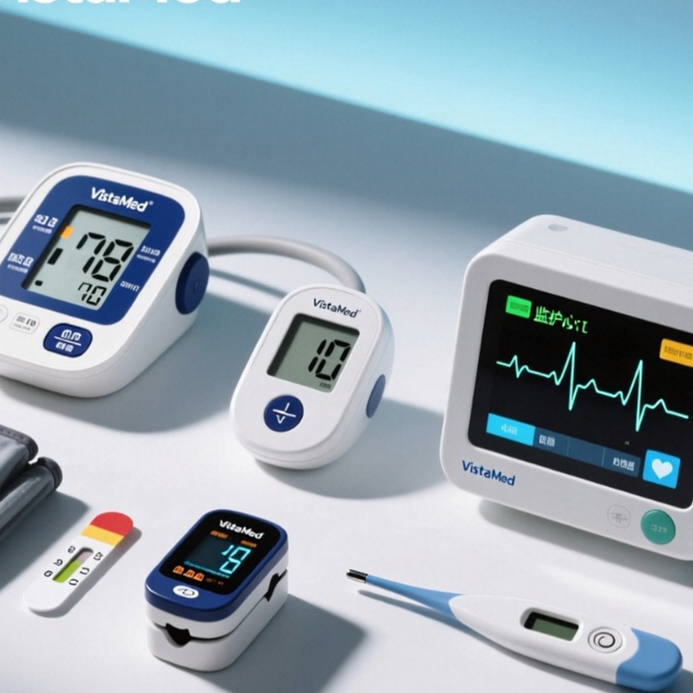
This isn't just a theory; it's backed by data. An independent evaluation by MedVal-Labs provided a clear example of this. They found that while premium devices from manufacturers like Omron (HEM-907XL) and Welch Allyn (Connex ProBP) offer excellent accuracy, the VistaMed ABPM-300 provides a more favorable TCO profile due to its durability and lower long-term maintenance needs.
That is your sales argument. You aren't selling a more expensive device; you're selling a less expensive 5-year cost.
You translate a technical standard into a clinical benefit. Don't just say a device is "accurate."
A professional upper arm blood pressure monitor must be clinically validated against the globally recognized standard, ISO 81060-2. You explain that this means the device's performance has been rigorously tested against a strict protocol defined by international experts, including those from organizations like the Association for the Advancement of Medical Instrumentation (AAMI).
When you can say, “Our manufacturing partner not only validates to this standard but also has engineers who sit on the AAMI committees that help develop these standards,” you are no longer just a salesperson. You are a trusted advisor representing an industry authority.
It comes down to three things that matter in a clinical environment: durability, data, and dependability.
Durability: A professional monitor is built to withstand the rigors of a hospital. The casing uses higher-grade polymers that can handle thousands of wipes with harsh hospital disinfectants without becoming brittle.
Data: It's designed for clinical workflow. A professional device like our ABPM-300 includes features like a dual-user 2x99 memory and a simple USB export to get data out of the device and into a clinical record.
Dependability: This is guaranteed by the warranty. A consumer device may have a one-year warranty. A true professional-grade device should be backed by a comprehensive 5-Year Standard Warranty, signaling the manufacturer's confidence in its own build quality and promising your customer years of reliable service.
You should demand a true partnership, not just a product. This means full transparency and deep support. Specifically, you must require:
The most successful distributors understand these answers. They sell solutions, not just devices. And in doing so, they protect their margins and build a business that lasts.
About the Author
Fang Chen (陈芳) serves as Director of Global Product Strategy & Customer Insights at VistaMed Technologies. She is the vital link between VistaMed's engineering teams and healthcare professionals, with 15 years of experience gathering deep insights from over 500 client facilities and global distribution partners. This article draws on her countless conversations with distributors about the hidden costs of low-quality suppliers and the ROI of a true quality partnership.
Clinically & Regulatory Reviewed By: Dr. Evelyn Reed, MD, Lead Medical Content Reviewer & Clinical Advisor
Medical Disclaimer:The information provided is for informational purposes and intended for a B2B audience of healthcare professionals and procurement decision-makers. It is not a substitute for professional medical or financial advice. TCO and ROI results may vary based on facility size, usage patterns, and local market conditions. All certifications and regulatory clearances referenced are accurate as of the date of publication. Please contact VistaMed Technologies for the most current documentation.

2026/02/25