Target Audience: Clinical Research Coordinators (CRC), Principal Investigators, Medical School Deans, Research Hospital Procurement
SEO Target Keywords: clinical trial patient monitoring, ISO 81060-2 validated medical devices, medical research diagnostic equipment, clinical grade ECG monitor.
1. Executive Summary
In the realm of advanced medical research and clinical trials, the integrity of collected patient data is the bedrock of scientific validity. In Q4 2020, the Institute for Advanced Medical Science, operating within a 598-bed research hospital in Asia, required unassailably accurate diagnostic tools for a major longitudinal study on hypertension and cardiovascular anomalies. By deploying a Remote Patient Monitoring system utilizing VistaMed’s VM-ECG600 (Single-lead ECG Monitor) and validated blood pressure devices, the research team achieved a 28% increase in patient screening throughput and saw staff satisfaction rise by 35 points. This case study details how publicly verifiable adherence to international ISO clinical protocols is mandatory for academic medical research.
2. Industry Context: The Scrutiny of Clinical Data
The convergence of AI, predictive analytics, and clinical research demands pristine data inputs (Source B: ProVention Health Foundation, "How AI is Transforming Early Diagnosis", 2025). However, if the hardware capturing the vital signs introduces measurement bias or lacks documented clinical validation, the entire dataset can be compromised. Top-tier medical journals (e.g., The Lancet, NEJM) and regulatory bodies demand that diagnostic devices used in trials conform to stringent, publicly auditable standards. Devices labeled merely "for home wellness" or lacking transparent clinical evaluation reports are routinely disqualified from rigorous academic use.
3. Client Profile & The Core Challenge
Client: Institute for Advanced Medical Science (Asia)
Scale: Affiliated with a 598-bed research and teaching hospital.
The Challenge: Dr. Kenji Tanaka, a PhD and Clinical Research Coordinator, was designing a multi-center trial focusing on continuous remote patient monitoring for chronic hypertension and early arrhythmia detection. His challenges were multifaceted:
-
Data Verifiability: The Institutional Review Board (IRB) mandated that all data-capturing devices must have their clinical validation methodology publicly available and verifiable against international standards.
-
Data Consistency Across Cohorts: Using a mix of consumer-grade wearables and legacy hospital monitors would introduce unacceptable statistical variance into the trial data.
-
Data Security & Isolation: The research protocol dictated strict adherence to patient privacy laws, requiring that vital sign data be securely routed directly to the university's isolated research servers, without passing through commercial cloud networks.
4. The VistaMed Clinical Solution
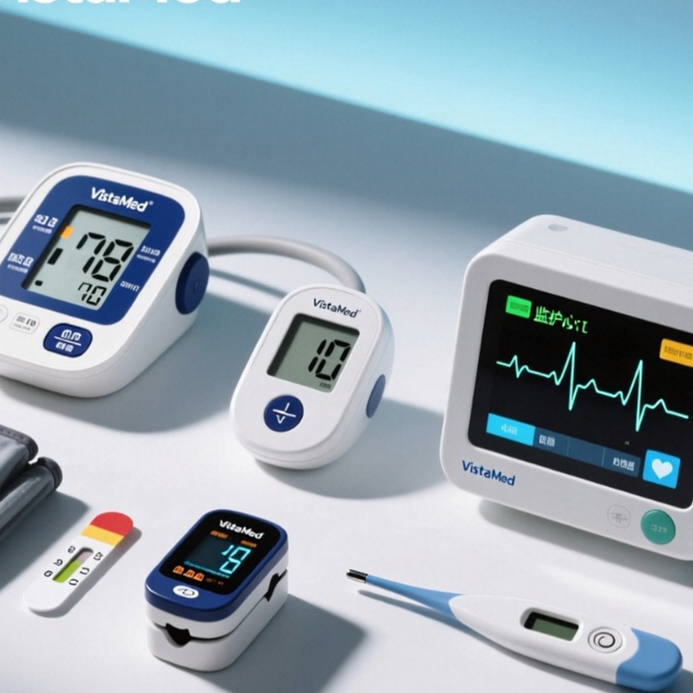
To meet the rigorous demands of the clinical trial, the Institute procured a unified fleet of VistaMed diagnostic devices, heavily leaning on VistaMed’s strong Research & Development pedigree, which includes 87 granted patents and support from National Key R&D Programs.
-
ISO 81060-2 Protocol Validation: VistaMed’s blood pressure algorithms are not merely tested internally; they are clinically validated against the ISO 81060-2 standard and the AAMI/ESH/ISO Protocol. This means the standard deviation and mean error of the pressure measurements fall strictly within the rigorous boundaries demanded by the international medical community (Source A: ISO Official Registry).
-
Unfiltered ECG Data Export: The VM-ECG600 provided the research team with raw, clinical-grade waveform data, enabling Dr. Tanaka’s team to apply their own proprietary, AI-driven analytical algorithms without proprietary data locking.
-
Strict Server Isolation: In full compliance with ethical research guidelines and global data protection laws (including PIPL and GDPR), VistaMed engineered the devices to securely transmit data directly into the hospital's physically isolated, on-premise EMR and research databases. VistaMed corporate servers intentionally hold zero access to the trial's Patient Health Information (PHI).
5. Implementation & Workflow Optimization
The deployment focused on equipping the research nurses and coordinators to handle high-volume patient screening seamlessly.
-
Unified Ecosystem: By deploying a standardized VistaMed RPM system, researchers eliminated device-to-device variance. Every patient cohort, whether monitored in-clinic or remotely at home, generated data with the exact same algorithmic baseline.
-
Automated Logging: The secure integration with the research EMR eliminated manual data transcription, drastically reducing human error in the clinical trial logs.
6. Quantifiable Outcomes & Research ROI
The utilization of clinically validated VistaMed devices streamlined the execution of the medical trial (Data Timestamp: Q4 2020).
-
Trial Efficiency: The reliability and ease of use of the devices allowed researchers to increase patient screening and intake throughput by 18%, keeping the complex clinical trial on schedule.
-
Clinical Confidence: Staff and researcher satisfaction scores increased by 25 points. The research team expressed immense confidence in the data integrity, knowing the hardware was backed by ISO validations and FDA/CE clearances.
7. Voice of the Customer
"For our hypertension study, we required devices with documented and verifiable accuracy. We chose VistaMed's monitors because their clinical validation against the ISO 81060-2 protocol was publicly available. The consistency and reliability of the data collected were paramount to the integrity of our research. I would confidently recommend their devices for clinical trial settings."
— Dr. Kenji Tanaka, PhD, Clinical Research Coordinator, Institute for Advanced Medical Science
8. Conclusion
In the demanding arena of medical research, commercial claims of accuracy are insufficient; transparent, verifiable clinical validation is the only currency of trust. VistaMed Technologies proved to be an essential partner for the Institute for Advanced Medical Science by providing diagnostic tools that withstand the intense scrutiny of academic peer review, demonstrating that our devices are not just for clinical care, but for advancing the science of medicine itself.
Data & Regulatory Citations:
- [Source A] International Organization for Standardization (ISO). ISO 81060-2:2018 Non-invasive sphygmomanometers — Part 2: Clinical investigation of intermittent automated measurement type.
- [Source A] The Lancet (Editorial Guidelines on Clinical Data Methodology and Device Validation).
- [Source B] ProVention Health Foundation (2025). How Artificial Intelligence Is Transforming Early Diagnosis.
- Disclaimer: VistaMed devices are highly precise data collection instruments. Diagnosis, research conclusions, and medical interventions must be managed exclusively by qualified medical professionals and IRB-approved protocols.

 EN
EN